 Newsverz
Science ·
Hubble Discovers Mysterious Ten-Sided Weather Pattern at Saturn's South Pole
Astronomers using the Hubble Space Telescope have identified a massive ten-sided atmospheric pattern circling Saturn's south pole, roughly 104,000 miles wide, marking the first large polygon-shaped jet stream observed in the planet's southern hemisphere.
AI-synthesized from the cited sources below.
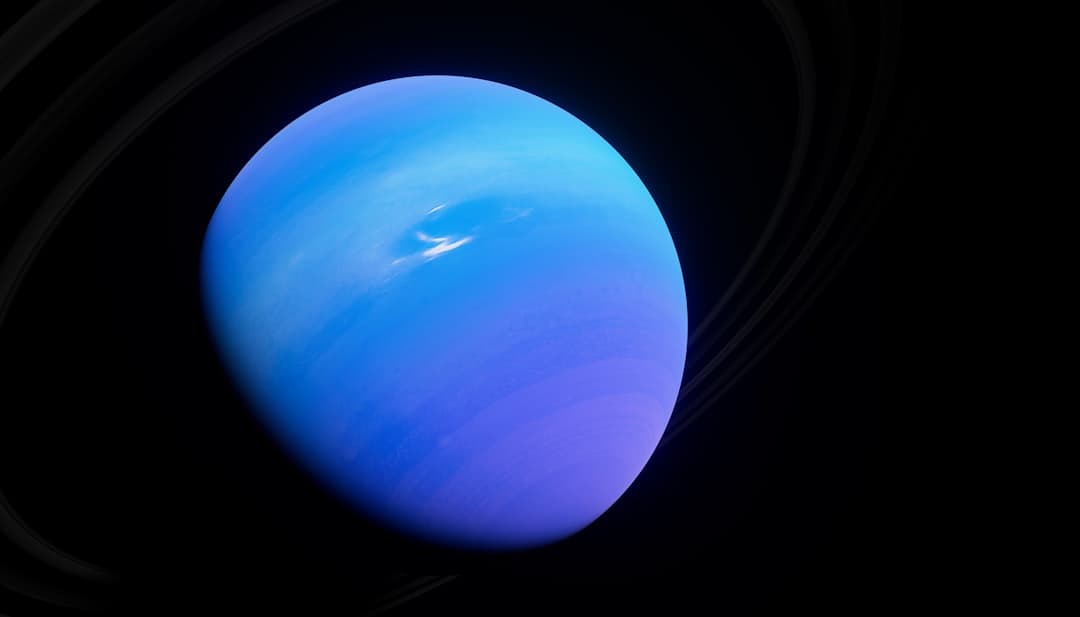
Astronomers using the Hubble Space Telescope have discovered a massive ten-sided atmospheric feature encircling Saturn's south pole, spanning roughly 104,250 miles across, or about 10,425 miles per side, according to findings published in the journal Science Advances. It marks the first large polygon-shaped jet stream pattern observed in Saturn's southern hemisphere, a striking counterpart to the famous hexagonal jet stream that has circled the planet's north pole for decades.
Researchers said the decagon appears to have begun emerging gradually over the past several years, based on a review of Hubble observations dating back to 2023. Scientists believe these polygonal atmospheric patterns form from complex interactions between fast-moving jet streams at different latitudes, though the underlying dynamics that determine the exact number of sides remain an active area of study. The discovery adds to a growing picture of Saturn's atmosphere as one of the most dynamic and geometrically unusual in the solar system.
Key facts
- Hubble discovered a ten-sided atmospheric pattern circling Saturn's south pole, about 104,250 miles across
- It is the first large polygon-shaped jet stream observed in Saturn's southern hemisphere
- It is a counterpart to Saturn's well-known hexagonal jet stream at the north pole
- The pattern appears to have gradually emerged over the past several years, based on Hubble data since 2023
- Findings were published in the journal Science Advances
Related articles

Science ·
NASA's Roman Space Telescope Launches Toward Deep Space Survey Mission
NASA's Nancy Grace Roman Space Telescope launched from Kennedy Space Center on a SpaceX Falcon Heavy rocket, beginning a roughly month-long journey to a gravitationally stable point beyond Earth's orbit where it will survey the cosmos roughly a thousand times faster than the Hubble Space Telescope.

Science ·
Scientists Discover Hidden Heat Anomaly Deep Beneath Mars's Southern Hemisphere
A new study using gravity measurements reveals that the interior beneath Mars's southern hemisphere may be 200 to 400 degrees Celsius hotter than the north and partially molten, offering clues to the planet's magnetism and geologic history.

Science ·
Nonprofit Plans 80,000-Year Mission to Alpha Centauri - for Under $15 Million
A Redmond-based nonprofit wants to launch the first spacecraft deliberately aimed at another star system by 2029, using an AI-plotted trajectory and a budget smaller than many single satellites.

Science ·
NASA's Roman Space Telescope Launches on Falcon Heavy Toward Deep Space Survey Mission
NASA's Nancy Grace Roman Space Telescope lifted off successfully aboard a SpaceX Falcon Heavy rocket, beginning a mission to survey billions of galaxies and search for exoplanets from a vantage point a million miles from Earth.

Science ·
Astronomers Capture Clearest-Ever Image of Betelgeuse's Long-Suspected Companion Star
An international team using the European Southern Observatory's Very Large Telescope has produced the sharpest image yet of a faint companion star orbiting Betelgeuse, closing in on a mystery astronomers have debated for nearly a century.
Comments
Loading comments...